Work

The Answer Was Always in the Evidence

Twelve engagements. Four continents. Banking, consumer goods, hospitality, insurance, retail, real estate, healthcare, technology. In every case, the answer was not in the obvious place. It was in the evidence no one had thought to examine.

Industry
Region
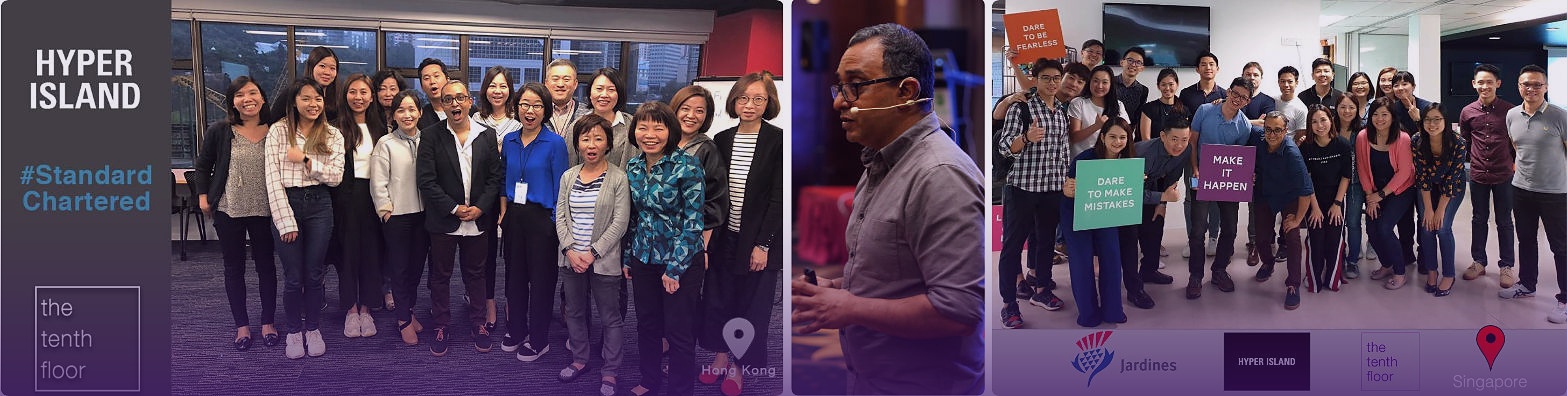
Jardines / Hyper Island leadership cohort, Singapore
Standard Chartered · Jardines · Hyper Island, Hong Kong & Singapore

Holistic financial planning landed because it was built on what the segment felt.

OCBC came in with a brief about financial planning for young parents. The data they held was informative about behaviour: what the segment was buying, when, in what volume. It said nothing about why the decisions felt so difficult.

The investigation turned to forums where Singapore parents have conversations they do not have in focus groups or surveys. The finding was not a product gap or a messaging problem. It was a tension: the conflict between providing every advantage for one’s children and securing one’s own financial future, present in every authentic conversation and absent from every formal research channel.

Holistic financial planning tools were launched around that tension. Research costs fell by more than 50 percent. The product landed because it was built on what the segment felt, not what they said when someone was recording the responses.

The pattern: the most commercially powerful consumer tensions are often the ones that cannot surface in formal research because they are too uncomfortable to state directly. The investigative approach finds them in the evidence that exists outside the formal channel.

The insight was in public data the whole time.

Mastercard was watching the same domestic payment competitors every card company was watching. Tourist behaviour data from the top five arrival countries told a different story. Singapore’s MRT was consistently rated a top attraction in the actual conversations tourists were having online. No one in financial services was treating it as a commercial opportunity. The visible problem was absorbing all available attention.

An exclusive five-year first-mover partnership with SMRT followed. Cross-border transaction volume increased materially. The deal was covered in Bloomberg. The insight was in public data throughout.

The pattern: disruption concentrates competition around the obvious problem, which makes the non-obvious, discoverable only through systematic investigation, the most commercially available territory.

The evidence pointed somewhere the brief had not anticipated.

Nestlé arrived with a health-positioning strategy for Green Coffee. The health angle was logical, internally consistent with the brief, and aligned with the category’s prevailing direction. The evidence pointed somewhere else entirely.

What Indonesian consumers were saying in their own language, in their own online spaces, pointed to beauty benefits. The angle was not in the brief. Nestlé moved from trailing the competition to leading the category, starting with social media posts and scaling to the brand’s main campaign.

The pattern: the evidence will not always confirm the brief. An engagement built to investigate before concluding will find the answer the brief could not have anticipated.

When the market resets, don’t reduce price. Re-read the market.

Hilton was facing declining bookings in the post-pandemic domestic travel market without wanting to resort to price reductions, a strategy that would erode both revenue and the premium positioning the brand had spent decades building.

The investigation used publicly available data to map what post-pandemic travellers were actually choosing, not what they said they preferred. Statistical methods identified which amenities correlated most strongly with booking decisions for specific segments.

Bookings increased by 17 percent. No advertising spend. No price reductions. Premium positioning held throughout.

The pattern: when a market structurally resets, the instinct is to reduce price. The more durable response is to understand what the market now values, which, after a structural reset, is rarely what it valued before.

Measurement strategy must precede analysis.

Frasers Northpoint faced uneven customer traffic across tenants, with no systematic way of understanding which tenants were driving the highest-value footfall, or why.

The investigation built three layers of data collection (digital voucher distributions, geolocation data, redemption rates) and used them to identify the tenant locations and timing patterns that correlated with high-value customer behaviour. The result was a personalised recommendation system with dynamic vouchers adapted by location, time, and store context.

Footfall increased by 150 percent. The operating model shifted from intuition-based tenancy management to evidence-based optimisation.

The pattern: measurement strategy must precede analysis. The organisations that build the right data collection layer first create a compounding advantage over those that inherit legacy systems and retrofit meaning onto them.

From data-generating to data-driven, by building the missing measurement layer.

Great Eastern had built two functional mobile applications, one for customers, one for agents, without the measurement infrastructure to understand how either was actually performing. The applications generated data. They did not yet generate insight.

The investigation built the analytics and identity-resolution layer the applications were missing, integrated the attribution frameworks that made user behaviour legible to the product teams, and established the measurement baseline from which improvement could be tracked.

The applications moved from transactional tools to strategic assets. UI and UX evolved based on actual behaviour. Loyalty and retention data became actionable.

The pattern: the gap between a data-generating organisation and a data-driven one is not product quality. It is the measurement layer built on top of operations.

Talent attraction is more precisely an intelligence problem than a brand problem.

XL Axiata needed to attract senior digital talent (ML engineers, cloud architects, cybersecurity specialists) without evidence-based understanding of what motivated that specific cohort in that specific market at that specific moment.

The investigation analysed 19,948 talent and job profiles across 773 companies, identified 797 unique skills, and mapped supply and demand gaps across the market. Twelve career-motivating factors were tested through multivariate analysis.

LinkedIn following increased by more than 230 percent. XL Axiata became the destination employer for digital-transformation talent in Indonesia.

The pattern: talent attraction is more precisely an intelligence problem than a brand problem. What motivates the talent a specific organisation needs, in a specific market, at a specific time, that is an answerable empirical question, and last year’s answer will not transfer to this year.

Lead allocation is as commercially significant as the sales process itself.

ASBL’s call centres handled between 10,000 and 30,000 inbound calls daily from prospective luxury apartment buyers. There was no systematic way of distinguishing high-conversion leads from low-conversion leads at the point of intake.

The investigation analysed thousands of historical calls using speech-to-text AI, identified trigger words and conversation flow patterns most strongly correlated with conversion, and built a real-time lead scoring system from the findings.

Conversion speed improved by 20 to 30 percent with the same call volume. Sales scripts were refined on evidence. Agent training became measurable and targeted.

The pattern: in any high-volume, high-unit-value sales context, how resources are allocated across leads is as commercially significant as the quality of the sales process itself.

Customers already say what they need, in spaces where no surveyor is listening.

HSBC needed to understand the financial concerns of mass-affluent Premier customers (parents aged 25 to 40) in ways traditional research methods could not access. The question was not what this segment said they needed. It was what they actually needed, as revealed in their own conversations in spaces where no surveyor was listening.

The investigation built a data pipeline to mine a full year of online forum discussions, identifying 266 distinct customer concerns. These were validated with 726 Premier customers over seven days via Facebook, tracking 3,480 interactions.

HSBC launched education consultancy services for Premier customers, a product that emerged entirely from the evidence, and that the research methods standard in banking had not surfaced.

The pattern: customers already say what they need, in the spaces where no surveyor is listening. The institution that builds the pipeline to read those conversations first claims product territory before the formal research cycle catches up.

Public digital signals are more honest than controlled research environments.

Pfizer (now Haleon) needed to understand shifting consumer attitudes toward wellness across two culturally distinct Asian markets at once. Traditional surveys could not capture authentic behaviour-level sentiment across such different cultural contexts.

The investigation used public digital signals, search data from Google in Taiwan and Baidu in China, to map actual consumer behaviour rather than stated preference. Chinese consumers were moving toward functional foods; Taiwanese consumers were engaging with lifestyle diseases and natural detox. The two markets required entirely different strategic responses.

Innovation pipelines were re-prioritised. Messaging moved to culturally resonant value propositions in each market.

The pattern: public digital signals are more honest than controlled research environments because they reflect actual behaviour rather than stated intention. Monitoring them continuously gives organisations a lead on what is shifting.

Repeat engagement requires working upstream of behaviour.

Singapore Zoo needed to shift from a one-time visit model to a repeat-engagement model with local families. The question was not how to make the zoo more appealing in the abstract. It was what specific job a visit could perform for a Singapore family, and whether the zoo was currently performing that job.

The investigation identified parenting priorities and the points of family friction a zoo visit could resolve, using data analytics rather than survey methods.

KidsWorld was launched, designed around those specific family needs. Footfall increased. Time spent per visit increased.

The pattern: measuring what visitors do is not the same as understanding why they would return. Repeat engagement requires working upstream of behaviour, into the motivations that precede it.

They were selling a computer. The buyer was raising a child.

Every PC maker in India was fighting the same visible war. Smartphones were already in everyone’s hand, so the category argued the obvious case: a computer is faster, bigger, more capable than the phone you own. First-time buyers were pitched on specifications and price. The rival was the smartphone, and the whole market was crowding around it.

The conversations first-time buyers were actually having weren’t about devices at all. They were about life’s jobs to be done: a parent wanting a child to outgrow them, someone wanting to start a business, to learn fast without needing English, to not be limited by where they were born, to create and change things. We built stimuli around those motivations and tested them with real people across fifteen cities in three languages, watching which aspirations pulled hardest and which device a person reached for to serve each one.

The work surfaced the single motivators only a PC could satisfy, drawn from a sample of thirteen thousand and turned into True Stories that earned brand lift and public discourse of their own. The aspiration was in plain conversation the whole time.

The pattern: when a category fixates on the obvious rival, the buyer’s real motivation, the job only your product can do, is left lying unclaimed.

The growth was sitting outside the believers.

As the default leader in Traditional Chinese Medicine, the instinct was to protect the core: the consumers who already trusted TCM and bought it. That is where the category spent its attention, talking to the converted and defending ground it already held. The visible problem absorbed everything.

Public health and wellness conversations on Reddit and Kaskus told a different story. People who had never bought TCM were already circling herbal and natural remedies, wanting to believe, held back only by the absence of conventional science to reassure them. Skincare surfaced as territory where consumers openly credited TCM as ahead of western medicine. Immunity, sleep, and everyday lifestyle damage control showed up as motivators that could widen the brand’s appeal far beyond its base. Propositions like wanting a family to build its immunity naturally were lifted straight from what people were saying.

Across roughly two thousand two hundred discussion threads and nine core themes, the conversations were converted into testable proposition statements for Hong Kong and Indonesia: a market expansion map built from words consumers had already written in public.

The pattern: defending the core hides the larger market: the non-believers, discoverable only by reading the conversations no one else in the category was bothering to read.

The advantage wasn’t in the fare. It was in the data exhaust.

Intercity bus operators compete on the levers everyone can see: the ticket price and the busiest, most contested routes. For an electric fleet, where a wrong route or a mispriced seat ties up capital that cannot be quietly redeployed, that visible game is also the most crowded one. Everyone optimises the same two dials.

The signal sat in data nobody was treating as a commercial input: chat transcripts, telephone conversations turned into text through speech recognition, forms and emails, app usage, time spent on each page, residence status and handset. Folded into a route-and-price simulator, these features let the fleet model real demand and test pricing before committing to a route rather than after.

The result was a simulator that turns ordinary operational exhaust into route and price decisions taken before the large, irreversible investment is made: the optimisation moved upstream of the spend.

The pattern: when every operator optimises the one visible lever, the real edge hides in the operational data everyone collects and no one treats as a decision.
What senior leaders said

Working with The Tenth Floor.

“The expert team uncovered new insights and opportunities that shaped our future communications strategy led by data. Extremely professional, knowledgeable and committed.”

Hiren Desai
Regional Head of Digital Marketing, Standard Chartered

“Their methods are both cost effective and time effective. Particularly useful in the current times when almost everything must move at the speed of disruption.”

Juan Juan Huang
SEAT Innovation Lead, Haleon (formerly Pfizer)

“There are ‘numbers’ people who get data but can’t turn that into insight or develop strategy. Or strategy people who don’t get digital metrics. The Tenth Floor does both, to a world-class standard.”

Daniel Lee
Digital Product and Transformation Leader, formerly McDonald’s Digital

Have a question that remains unanswered?

Take a meeting with the leadership team. No pitch. No proposal. A conversation about the real question underneath the problem.